Category: Uncategorized
Digital Media and Education
This podcast is about the impact of digital media on education, it specifically highlights the example of a game based learning technique “MERIT” adopted by various universities to train construction management students. The main aim of this podcast is to convey the message that digital media has an upper edge to improve student learning and engagement provided the students are aware of the consequences of irresponsible use of digital media and the internet. The strategy used to come up with this particular podcast was to relate to the current digital media technique used by universities that have a positive impact on student learning and engagement. The article by Murray and Buchanan on how children and young adults are more aware of the correct usage of digital media and internet helped me narrow down my topic to MERIT game and its impact on students. It was challenging and tough to narrow down the podcast topic to one particular example of digital media tools. As schools and universities have come up with a wide variety of game based learning techniques all of which are equally effective to improve student learning. The content with regards to digital media and its impact on education is vast and therefore, it was really challenging to plan and script the content of the podcast. I ensured that the content I speak of in the podcast is to the point and gives a clear understanding of what the listeners need to understand. Personally this is the first time i am using sound cloud to create a podcast and since I am not a well-informed user of it i tried to keep the podcast simple without any enhancing media to support it. Since it was the very first time i was creating a podcast the whole experience of it was a bit overwhelming. I has a lot of questions and got stuck in a lot of ways when it came to the editing of the content to best convey my message. I had to record the content multiple time before i came up with a decent one that i could post. The experience of creating this podcast has made me a bit more confident using it as a medium to communicate better in the future. The next time i would try to introduce some music and artwork to support my podcast content and make it more interesting for the listeners.
References
Buckingham, D. (2007). Digital Media Literacies: rethinking media education in the age of the internet. Research in Comparative and International Education , 43-55.
Game, T. I. (n.d.). The International Construction Business Game. Retrieved May 10, 2019, from https://meritgame.com/universities/benefits: https://meritgame.com/universities/benefits
Tiana Murray, R. B. (2018). “The internet is all around us”: how children come to understand the internet. Digital Culture and Education , 1-22.
References
Buckingham, D. (2007). Digital Media Literacies: rethinking media education in the age of the internet. Research in Comparative and International Education , 43-55.
Game, T. I. (n.d.). The International Construction Business Game. Retrieved May 10, 2019, from https://meritgame.com/universities/benefits: https://meritgame.com/universities/benefits
Tiana Murray, R. B. (2018). “The internet is all around us”: how children come to understand the internet. Digital Culture and Education , 1-22.
DIGITAL MEDIA AND CULTURAL HERITAGE
Cultural heritage is basically the tangible and intangible artifacts and attributes that a society or group inherits from their ancestors and preserved to pass it on to the future generations. Cultural heritage is significant as it is the identity of a particular group or country that is introduced to the world. The advancement in digital technology and innovations has had a very big and positive impact on producing, preserving and accessing cultural heritage and made it easy to share the culture throughout the world. There is an increasing need for the preservation of cultural heritage in more ways than the traditional means of museums. With the increase in immigration and movement of social groups from one part of the world to another due to wars pose an increasing need for digitally creating monuments, forts and cities. This will help the culturally relevant information to prevail irrespective of the damage caused in that area.
This particular blog will highlight how digital media has impacted cultural heritage over a period of time. The past decade various digital projects for cultural heritage have been taken up across the world. These projects vary from 3-D visual effects, modeling of archaeological sites, preservation and curation of cultural heritage materials and digital technologies provides us with a new insight to understand the past. There are two different ways in which digital technology can be used to preserve cultural heritage, one is creating electronic copies of cultural antiquities and artifacts like electronic museums, e-library, electronic exhibits etc. Digital archives however need to be managed in an effective way. This will ensure long term preservation of all the archives and not allow any editing or artifaction of any data. Any organization that is involved in archiving cultural heritage should be accountable and have the right resources for creating and maintaining the archives.
The other method is digital forms of new cultural artifacts that in future might become objects of cultural heritage. Digitization of culturally relevant information will also help in having unified and easy access to any of the information related to the culturally important antiques. For example, if a person is visiting the Louvre in Paris to see the very famous Monalisa, he/she can obtain any relevant information about the painting and its importance while viewing the art. 3D rendering programs helps archaeologists recreate and depict the structural aspect of an archaeologically important site that does not have a lot of its remains left. This program helps not only the subject specialists but also the audiences get access to information that would not be available otherwise. With the digitization of all the information with regards to cultural heritage, it will also enable the authors, creators and other individuals involved in getting credit where it is due. Stereoscopy, another interesting aspect of digital technology is used to create a flat image from a 3 dimensional structure.
Major companies like Google are using stereoscopy to obtain 3D models of cities and sites which can lead to accessing these structures in the future. The increase in the models being developed by 3D imaging is posing an increase in need for creating a central archive for all the models obtained and created so far. All of the above-mentioned technologies will only create a wide range of accessible information for the general public. It also makes it possible to share and distribute the digital information to a large number of people within no time. Some limitations are also listed below. A limitation to the digitization of cultural heritage is that it eliminates the personal one on one interaction in the context of connection and interpersonal relation to tradition. Virtual images of the culturally important object may have a more impact or play a more dominant form of image in the viewer’s mind than the actual image.
In my personal opinion, digital technologies when applied to cultural heritage have more advantages rather than disadvantages. Using the various aspects of digital technology to preserve and access information that can be culturally important should be promoted. Instead of limiting the integration of digital technology, we should promote it to create more awareness and educate about cultural heritage. It will also stand as a great source of passing on culturally relevant information onto the future generations through various digital media portals. To provide a clear understanding of how digital technology and innovation has been used in reconstructing monuments and archiving information on cultural heritage, I have highlighted two examples in the video below.
Antonina A. Nikonova, M. V. (2017). The Role of Digital Technologies in the Preservation of Cultural Heritage. The American Historical Review , 169-180.
Laura King, J. F. (2016). Experiencing the Digital World: The Cultural Value of Digital Engagement with Heritage. Journal Heritage &Society , 76-101.
Nodjimbadem, K. (2016, March). The Heroic Effort to Digitally Reconstruct Lost Monuments. Smithsonian Magazine , p. 2016.
Purday, J. (2009). Think Culture: Europeana.eu from concept to construction. Bibliothek Frschung und Praxis , 170-180.
Tom Evans, L. H. (2011). Challenges of Digital Preservation for Cultural Heritage Institutions. Journal of Librarianship and Information Science , 157-165.
Creating an online identity
Creating an identity online was not a very conscious decision at first for me. It appeared to be one of the easiest modes of communicating my thoughts and keeping in touch with my family and friends. I have been active on a number of social media platforms that include Facebook, Instagram, Linkedin and recently Twitter (Lowenthal & Dennen, Distant Education, 38;2:137-140).

After becoming a regular user of all of these social media platforms, I became more aware of what online identity meant and what the world of social media can entail. Creating an identity then had a lot more meaning than I had imagined. I realised that social media can lead you to portray yourself in a different way than you recognise yourself to be. It then became a conscious choice to develop an identity or rather maintain my own identity on all my social media platforms. As an individual I always believed that being yourself and putting the real version of you out there is the best way to be. I followed this philosophy through my online journey on Instagram- my most preferred choice of social media application in today’s world. They say “a picture speaks a thousand words” and the idea of portraying my world through any form of digitial media appeals to me.

https://www.seedling.com/blogs/cultivate/42206211-the-importance-of-photography
Every individual has their own interpretation of art and as an individual who strongly believes in her choices and decisions, I have created an online identity that is very unique to my personality. As much as I am an extrovert, I also believe in limiting the access to my online content. This has ensured that my thoughts, images and videos are shared, watched and accessed only by my friends and family members who follow me on instagram. I had made the conscious decision to make my profile private and it is one choice I will always stay true to. With the growing concerns of privacy becoming a deep rooted issue in the world of internet, I believe that my online identity that reflects a lot of who I am remains private. This ensures that I am myself and not afraid of posting any of my views, photographs or videos on my instagram handle. It limits the engagement of the members on the instagram family however gives me the peace of mind that I am sharing any of those details with people who I have accepted and chosen to stay in touch with.
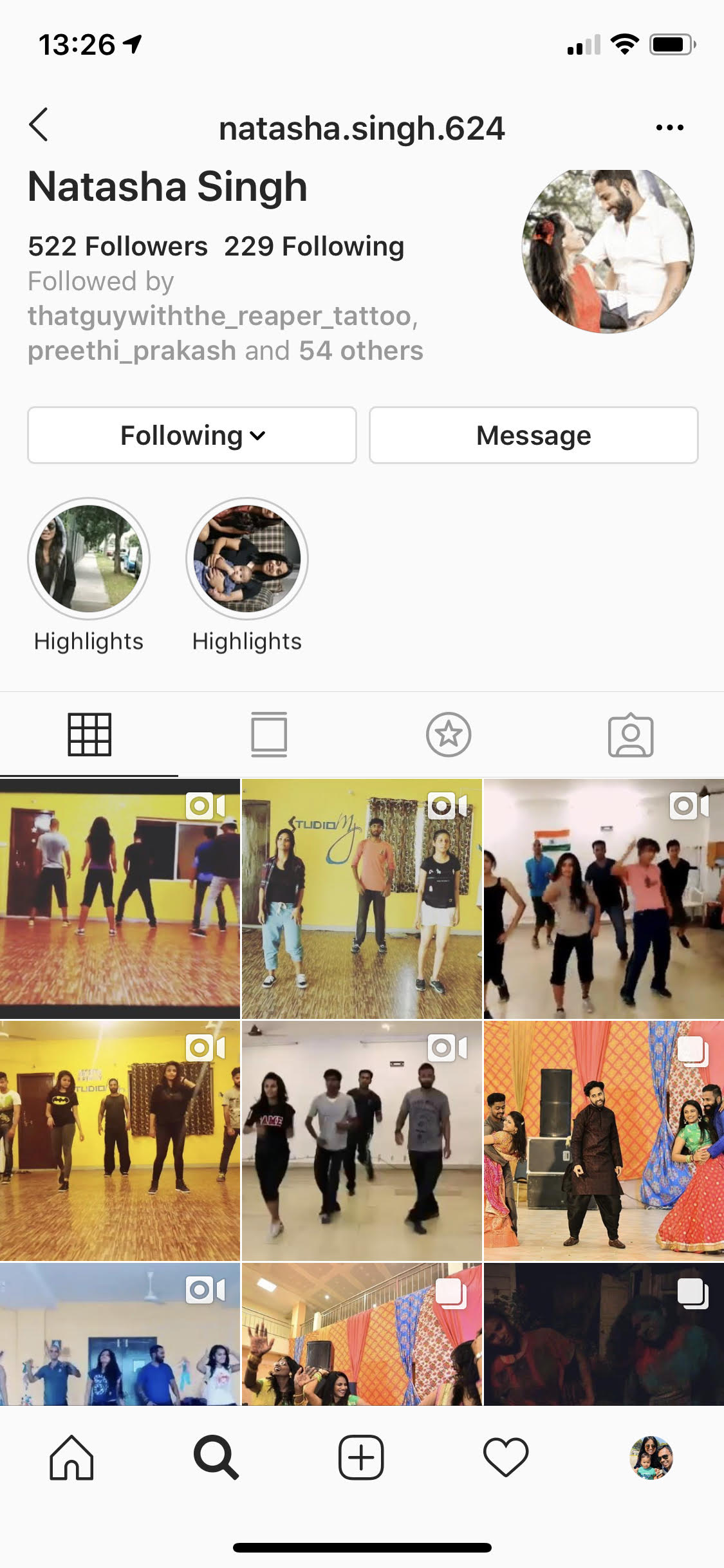
Although instagram has a lot to offer content wise, a feature that I have grown to be very fond of is termed as ‘boomerang’. It is a feature that was initiated by instagram and has grown heaps and bounds in popularity. The feature enables you to take a short video which then plays in a loop repeatedly.
Although most posts on my instagram account are a reflective of my everyday life, I have certain limitations on the kind of content I post or publish on any of my online media profiles. Ensuring my privacy through keeping the locations of my post generalised rather than providing a specific is critical to my profile. Inspite of all my social media profiles being private (accessible only by my friends) I am aware of the access that the general public can have to my photos and content. I keep a constant check on the privacy filters I use and update them from time to time to ensure restricted access to my instagram profile as well.
Reference(s)
Social presence, identity and online learning: research development and needs. Patrick R Lowenthal, Venessa P Dennen, Distant Education, 38;2:137-140.
The Journey Begins
Thanks for joining me!
Good company in a journey makes the way seem shorter. — Izaak Walton

 Life in the social world