Cultural heritage is basically the tangible and intangible artifacts and attributes that a society or group inherits from their ancestors and preserved to pass it on to the future generations. Cultural heritage is significant as it is the identity of a particular group or country that is introduced to the world. The advancement in digital technology and innovations has had a very big and positive impact on producing, preserving and accessing cultural heritage and made it easy to share the culture throughout the world. There is an increasing need for the preservation of cultural heritage in more ways than the traditional means of museums. With the increase in immigration and movement of social groups from one part of the world to another due to wars pose an increasing need for digitally creating monuments, forts and cities. This will help the culturally relevant information to prevail irrespective of the damage caused in that area.
This particular blog will highlight how digital media has impacted cultural heritage over a period of time. The past decade various digital projects for cultural heritage have been taken up across the world. These projects vary from 3-D visual effects, modeling of archaeological sites, preservation and curation of cultural heritage materials and digital technologies provides us with a new insight to understand the past. There are two different ways in which digital technology can be used to preserve cultural heritage, one is creating electronic copies of cultural antiquities and artifacts like electronic museums, e-library, electronic exhibits etc. Digital archives however need to be managed in an effective way. This will ensure long term preservation of all the archives and not allow any editing or artifaction of any data. Any organization that is involved in archiving cultural heritage should be accountable and have the right resources for creating and maintaining the archives.
The other method is digital forms of new cultural artifacts that in future might become objects of cultural heritage. Digitization of culturally relevant information will also help in having unified and easy access to any of the information related to the culturally important antiques. For example, if a person is visiting the Louvre in Paris to see the very famous Monalisa, he/she can obtain any relevant information about the painting and its importance while viewing the art. 3D rendering programs helps archaeologists recreate and depict the structural aspect of an archaeologically important site that does not have a lot of its remains left. This program helps not only the subject specialists but also the audiences get access to information that would not be available otherwise. With the digitization of all the information with regards to cultural heritage, it will also enable the authors, creators and other individuals involved in getting credit where it is due. Stereoscopy, another interesting aspect of digital technology is used to create a flat image from a 3 dimensional structure.
Major companies like Google are using stereoscopy to obtain 3D models of cities and sites which can lead to accessing these structures in the future. The increase in the models being developed by 3D imaging is posing an increase in need for creating a central archive for all the models obtained and created so far. All of the above-mentioned technologies will only create a wide range of accessible information for the general public. It also makes it possible to share and distribute the digital information to a large number of people within no time. Some limitations are also listed below. A limitation to the digitization of cultural heritage is that it eliminates the personal one on one interaction in the context of connection and interpersonal relation to tradition. Virtual images of the culturally important object may have a more impact or play a more dominant form of image in the viewer’s mind than the actual image.
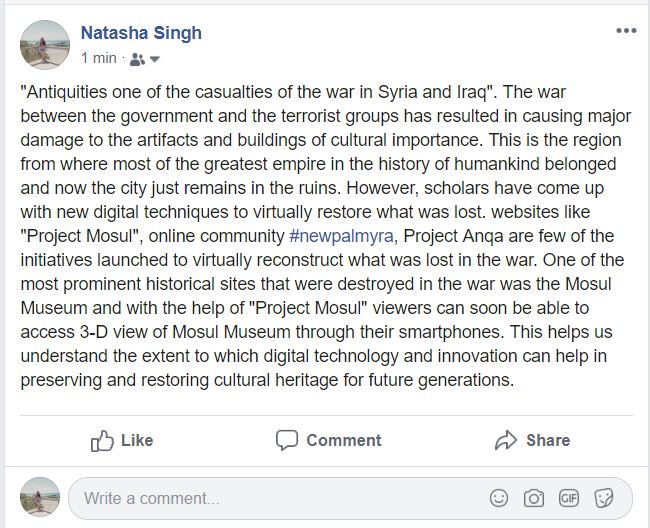
In my personal opinion, digital technologies when applied to cultural heritage have more advantages rather than disadvantages. Using the various aspects of digital technology to preserve and access information that can be culturally important should be promoted. Instead of limiting the integration of digital technology, we should promote it to create more awareness and educate about cultural heritage. It will also stand as a great source of passing on culturally relevant information onto the future generations through various digital media portals. To provide a clear understanding of how digital technology and innovation has been used in reconstructing monuments and archiving information on cultural heritage, I have highlighted two examples in the video below.
Antonina A. Nikonova, M. V. (2017). The Role of Digital Technologies in the Preservation of Cultural Heritage. The American Historical Review , 169-180.
Laura King, J. F. (2016). Experiencing the Digital World: The Cultural Value of Digital Engagement with Heritage. Journal Heritage &Society , 76-101.
Nodjimbadem, K. (2016, March). The Heroic Effort to Digitally Reconstruct Lost Monuments. Smithsonian Magazine , p. 2016.
Purday, J. (2009). Think Culture: Europeana.eu from concept to construction. Bibliothek Frschung und Praxis , 170-180.
Tom Evans, L. H. (2011). Challenges of Digital Preservation for Cultural Heritage Institutions. Journal of Librarianship and Information Science , 157-165.

 Life in the social world